We Use CookiesWe use cookies to enhance the security, performance, functionality and for analytical and promotional activities. By continuing to browse this site you are agreeing to our privacy policy

10 Best Graphics Cards For Gaming 2026 in the United States
How do we rank products for you?

Our technology thoroughly searches through the online shopping world, reviewing hundreds of sites. We then process and analyze this information, updating in real-time to bring you the latest top-rated products. This way, you always get the best and most current options available.

headphones-stars

Our Top Picks

#1

Winner

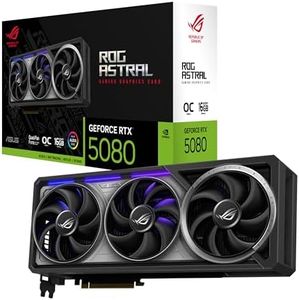
ASUS ROG Astral GeForce RTX™ 5080 OC Edition Gaming Graphics Card (PCIe® 5.0, 16GB GDDR7, HDMI®/DP 2.1, 3.8-Slot, 4-Fan Design, Axial-tech Fans, Patented Vapor Chamber, Phase-Change GPU Thermal pad)

Rating
10.0
Chosen by1,210
Cooling Solutions
Form Factor and Compatibility
Clock Speed

Most important from
128 reviews

Cooling Solutions
The card delivers excellent performance with stable operation even at high temperatures, maintaining reliability up to 80-90°C without aggressive fan noise.
Form Factor and Compatibility
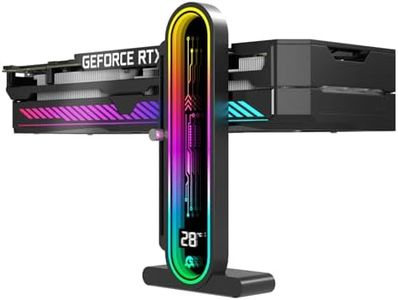
The GPU’s size requires consideration for case compatibility and benefits from a support bracket to prevent sagging due to its weight and length.
Clock Speed
The factory overclock provides a noticeable boost out of the box, with additional headroom for users interested in manual tuning.

The ASUS ROG Astral GeForce RTX 5080 OC Edition is a high-performance gaming graphics card designed to handle the latest games at high settings with smooth frame rates. It uses NVIDIA’s new Blackwell architecture and comes with 16GB of fast GDDR7 memory, meaning it can manage demanding visuals and higher resolutions without slowing down. The card supports advanced features like ray tracing and DLSS 4, which enhance game graphics and boost performance through AI. Cooling is a standout here — the quad-fan design combined with a patented vapor chamber and phase-change thermal pad helps keep the GPU running cool even during long gaming sessions. This means you get better stability and potentially longer hardware life.

The card is quite large (3.8 slots wide and about 14 inches long), so you’ll need to make sure your PC case can fit it and that your power supply can handle its power demands. With multiple DisplayPort 2.1 and HDMI 2.1 ports, it supports high-resolution monitors and multiple screen setups. This makes it a strong choice for gamers wanting top-tier performance and cooling, provided they have a compatible system that can accommodate its size and power requirements.

Rating
10.0
Chosen by1,210
Cooling Solutions
Form Factor and Compatibility
Clock Speed

Most important from
128 reviews

Cooling Solutions
The card delivers excellent performance with stable operation even at high temperatures, maintaining reliability up to 80-90°C without aggressive fan noise.
Form Factor and Compatibility
The GPU’s size requires consideration for case compatibility and benefits from a support bracket to prevent sagging due to its weight and length.
Clock Speed
The factory overclock provides a noticeable boost out of the box, with additional headroom for users interested in manual tuning.
#2

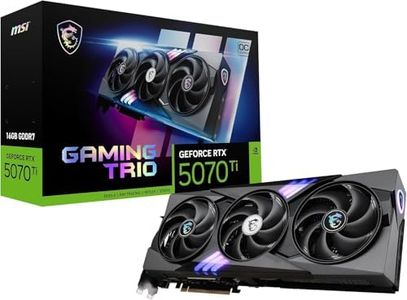
MSI NVIDIA GeForce RTX 5070 Ti 16G Gaming Trio OC Plus Graphics Card - 16 GB GDDR7 (28 GB/s, 256-bit), PCIe 5.0 - TRI FROZR 4 (3 x STORMFORCE Fans) - RGB - HDMI 2.1b, DisplayPort 2.1b

Rating
9.4
VRAM (Video RAM)
Cooling Solutions
GPU Architecture

Most important from
470 reviews

VRAM (Video RAM)
Offers a future-proof setup with ample VRAM and support for the latest technologies.
Cooling Solutions
Runs smoothly with efficient cooling, maintaining optimal temperatures during extended sessions.
GPU Architecture
Handles 1440p gaming effortlessly with high frame rates and enhanced visuals.

The MSI NVIDIA GeForce RTX 5070 Ti Gaming Trio OC Plus is a strong choice for gamers aiming for high performance at 1440p resolution. It features NVIDIA's latest Blackwell architecture and 16GB of fast GDDR7 VRAM, which helps with smooth gameplay and future-proofing. The card supports advanced ray tracing and DLSS 4.0, enhancing visual quality and maintaining higher frame rates in demanding games. With a 2572 MHz clock speed and powerful GPU cores, this card handles modern games with ease.

Cooling is a highlight here—the TRI FROZR 4 system uses three efficient fans with special blade designs and advanced heat pipes to keep temperatures low without much noise, which is great for longer gaming sessions. The metal backplate and sturdy build add durability while also helping with heat dissipation. The card is quite large (2.5 slots, 338mm length), so it’s important to check your PC case compatibility before buying.

Power consumption is on the higher side at 250W, meaning you'll need a quality 650W power supply, which is typical for cards in this class. It supports the latest PCIe 5.0 interface, offering faster data transfer if your motherboard supports it. Video outputs include three DisplayPort 2.1b and one HDMI 2.1b, good for connecting multiple high-resolution or high-refresh-rate monitors. Although the card's size and weight might not fit smaller cases easily and it is optimized for 1440p gaming rather than 4K, this MSI model remains a reliable and visually appealing option for gamers seeking a future-ready card with advanced ray tracing, strong cooling, and ample VRAM.

Rating
9.4
VRAM (Video RAM)
Cooling Solutions
GPU Architecture

Most important from
470 reviews

VRAM (Video RAM)
Offers a future-proof setup with ample VRAM and support for the latest technologies.
Cooling Solutions
Runs smoothly with efficient cooling, maintaining optimal temperatures during extended sessions.
GPU Architecture
Handles 1440p gaming effortlessly with high frame rates and enhanced visuals.
#3

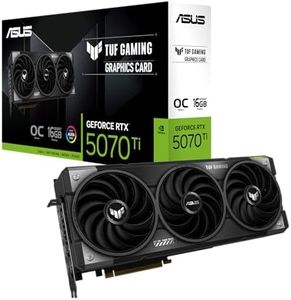
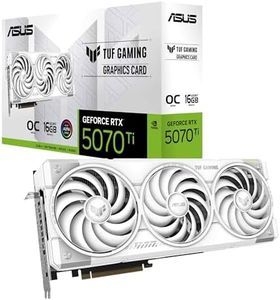
Asus TUF Gaming RTX5070 Ti OC, PCIe5, 16GB DDR7, 2 HDMI, 3 DP, 2610MHz Clock, RGB Lighting, Overclocked

The Asus TUF Gaming RTX 5070 Ti OC is a solid choice for gamers looking for strong performance and reliability. It comes equipped with NVIDIA’s latest RTX 5070 Ti GPU and 16GB of fast DDR7 video memory, which is plenty to handle modern games smoothly at high resolutions, including 4K. The card’s clock speed is an overclocked 2610MHz, giving it a nice boost in speed for gaming tasks. It also supports advanced features like ray tracing and DLSS, which enhance graphics quality and performance in supported games.

Asus has focused on durability and cooling with military-grade components and axial-tech fans that push 31% more air, along with a vented exoskeleton design that helps keep temperatures low during intense gaming sessions. The dual BIOS lets you switch between quieter or more powerful modes depending on your preference. While the card is fairly large due to its 3.125-slot design, it should fit well in most mid- to full-tower gaming PCs. It requires a quality power supply (around 850W or higher is ideal), so keep that in mind.

This graphics card is well suited for gamers who want a durable, high-performance GPU with advanced features and effective cooling, provided their setup can accommodate its size and power requirements.

Buying Guide for the Best Graphics Cards For Gaming

Choosing the right graphics card for gaming can significantly enhance your gaming experience. The graphics card, or GPU, is responsible for rendering images, videos, and animations, making it a crucial component for gamers. To pick the best graphics card for your needs, you should consider several key specifications. Understanding these specs will help you make an informed decision that aligns with your gaming preferences and requirements.
GPU ArchitectureThe GPU architecture refers to the design and technology used in the graphics card. It impacts the card's performance, efficiency, and features. Newer architectures generally offer better performance and support for the latest technologies. If you play modern, graphically intensive games, opting for a card with the latest architecture can provide a smoother and more immersive experience. For less demanding games, an older architecture might suffice.
VRAM (Video RAM)VRAM is the memory used by the GPU to store image data. It is crucial for handling high-resolution textures and complex scenes. More VRAM allows for better performance in high-resolution gaming and when using multiple monitors. For 1080p gaming, 4-6GB of VRAM is typically sufficient. For 1440p or 4K gaming, 8GB or more is recommended. Consider the resolution and detail level you prefer in your games when choosing the VRAM capacity.
Clock SpeedClock speed, measured in MHz, indicates how fast the GPU can process data. Higher clock speeds generally translate to better performance, especially in games that are more GPU-bound. However, clock speed is just one part of the equation, and it should be considered alongside other specs like the number of cores and architecture. If you want the best performance, look for a card with a high clock speed, but also consider the overall balance of the card's features.
CUDA Cores / Stream ProcessorsCUDA cores (NVIDIA) or stream processors (AMD) are the parallel processors within the GPU that handle the rendering tasks. More cores generally mean better performance, as the GPU can handle more tasks simultaneously. For high-end gaming, a card with a higher number of cores will provide better performance in demanding games. For casual or less graphically intense gaming, a lower number of cores may be sufficient.
Ray Tracing and DLSSRay tracing is a rendering technique that simulates realistic lighting and reflections, while DLSS (Deep Learning Super Sampling) is a technology that uses AI to boost frame rates while maintaining image quality. These features are important for gamers who want the most realistic and immersive visuals. If you play games that support these technologies and want the best visual experience, look for a card that offers ray tracing and DLSS support. If these features are not a priority, you can opt for a card without them.
Power ConsumptionPower consumption indicates how much power the graphics card requires to operate. It is important to ensure that your power supply unit (PSU) can handle the card's power requirements. High-performance cards typically consume more power, so you may need a PSU with a higher wattage. Check the recommended PSU wattage for the card you are considering and ensure your system can support it. If you are building a new system, factor in the power needs of all components.
Cooling SolutionsCooling solutions are essential for maintaining optimal GPU temperatures and preventing overheating. Graphics cards come with different cooling designs, such as single-fan, dual-fan, or liquid cooling. Better cooling solutions can improve performance and longevity. If you plan to overclock your GPU or use it in a high-performance setup, look for a card with robust cooling. For standard gaming, a dual-fan setup is usually sufficient.
Form Factor and CompatibilityThe form factor refers to the physical size and shape of the graphics card. It is important to ensure that the card fits in your computer case and is compatible with your motherboard. Check the dimensions of the card and compare them with your case's available space. Also, ensure that your motherboard has the appropriate PCIe slot for the card. If you have a compact case, look for a card with a smaller form factor.

FAQ