We Use CookiesWe use cookies to enhance the security, performance, functionality and for analytical and promotional activities. By continuing to browse this site you are agreeing to our privacy policy

10 Best Outdoor TV Antennas 2026 in the United States
How do we rank products for you?

Our technology thoroughly searches through the online shopping world, reviewing hundreds of sites. We then process and analyze this information, updating in real-time to bring you the latest top-rated products. This way, you always get the best and most current options available.

headphones-stars

Our Top Picks

#1

Winner

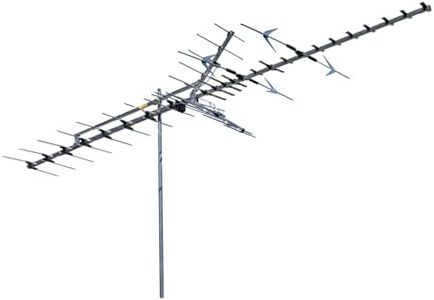
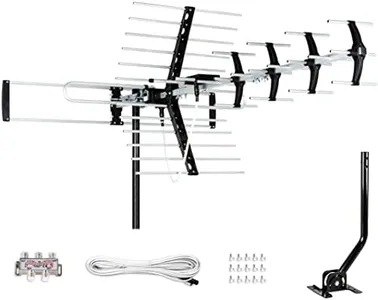
Winegard HD7698A Long Range Outdoor HDTV Antenna - 65+ Mile Range, High-VHF/UHF, 4K Ultra-HD Ready, Free Local Channels, Amplify with Boost XT LNA-200

Rating
10.0
Chosen by1,333
Range
Frequency Bands
Antenna Type

Most important from
119 reviews

Range
Ideal for fringe viewing and rural areas, capturing stations up to 74 miles away.
Frequency Bands
Excels in the high VHF (channels 7-13) and mid UHF (channels 14-36) ranges.
Antenna Type
A robust choice for receiving out-of-town stations, especially in challenging terrains.
Installation and Mounting
Installation can be complex due to its large size; best installed by two people.
Weather Resistance
Durable and weather-resistant, withstanding rough winters with minimal signal fade.

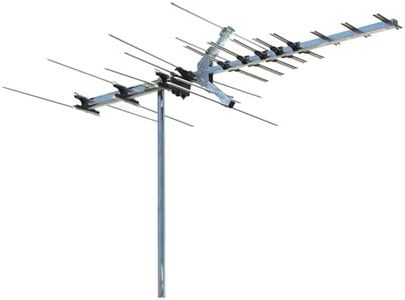
The Winegard HD7698A is a long-range outdoor HDTV antenna designed to capture both High-VHF and UHF signals, making it a solid choice for those looking to receive local channels without a cable subscription. With a claimed range of over 65 miles, it is particularly beneficial for users in rural areas where signal strength is often a challenge. The antenna is engineered to ensure efficient signal transfer, which is a significant advantage for maintaining a clear picture quality, especially when combined with the optional Winegard Boost XT LNA-200 amplifier for enhanced performance.

This model supports 4K Ultra HD signals and is designed to be future-ready for the ATSC 3.0 standard, allowing for advanced features like improved frame rates and 3D television viewing. This makes it appealing for tech-savvy consumers who want to be ahead of the curve with their home entertainment systems.

One noteworthy strength is Winegard's reputation as a reliable manufacturer, having been in the antenna business since 1954, which gives potential buyers confidence in its quality and durability. Additionally, the antenna is built for weather resistance, ensuring it can withstand various outdoor conditions. The installation process may be challenging for some users, particularly those unfamiliar with mounting outdoor devices. Some customers have noted that performance can vary depending on geographic location and obstructions like trees or buildings, which could limit the effective range.

Rating
10.0
Chosen by1,333
Range
Frequency Bands
Antenna Type

Most important from
119 reviews

Range
Ideal for fringe viewing and rural areas, capturing stations up to 74 miles away.
Frequency Bands
Excels in the high VHF (channels 7-13) and mid UHF (channels 14-36) ranges.
Antenna Type
A robust choice for receiving out-of-town stations, especially in challenging terrains.
Installation and Mounting
Installation can be complex due to its large size; best installed by two people.
Weather Resistance
Durable and weather-resistant, withstanding rough winters with minimal signal fade.
#2

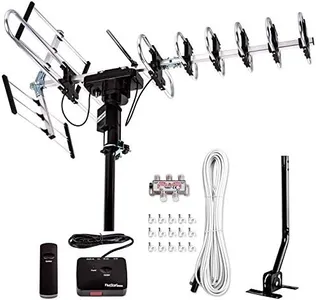
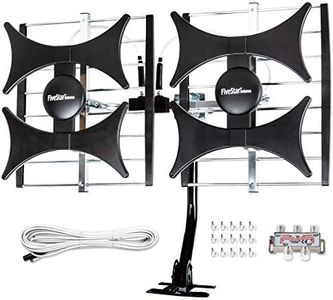
Five Star Outdoor Digital Amplified HDTV Antenna - up to 200 Mile Long Range,Directional 360 Degree Rotation,HD 4K 1080P FM, Supports 5 TVs Plus Installation Kit and Mounting Pole

Rating
10.0
Range (Reception Distance)
Directionality (Directional vs. Omnidirectional)
Antenna Size and Mounting Options

Most important from
9443 reviews

Range (Reception Distance)
Reception quality is outstanding, delivering crystal clear HD signals with no pixelation or dropouts across a wide range of local networks.
Directionality (Directional vs. Omnidirectional)
Directional rotation allows for fine-tuning the antenna quickly, although the turning mechanism moves rather fast and may require careful handling.
Antenna Size and Mounting Options
Setup is straightforward and fast, requiring no complicated tools or instructions to get the antenna mounted and scanning channels within minutes.
Weather Resistance and Durability
The build is both lightweight and sturdy, designed to withstand harsh weather conditions like wind and rain for long-lasting outdoor use.
Multiple Output Support
The antenna supports multiple TVs effectively, working well with splitters to deliver strong signals to up to eight TVs simultaneously.

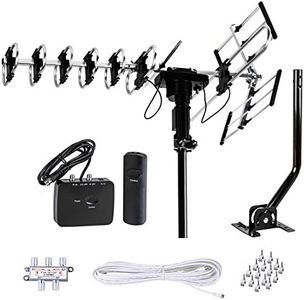
The Five Star Outdoor Digital Amplified HDTV Antenna is designed for people looking to access free local TV channels from a long distance, with an advertised range of up to 200 miles. It supports both VHF and UHF frequencies, covering common broadcast bands, and also includes FM radio reception. Its directional design combined with 360-degree rotation allows you to fine-tune reception by turning the antenna to face different broadcast towers, which helps improve signal quality in varied locations.

The antenna uses six reflector elements and a gain booster with auto gain control, enhancing signal reception and image quality, including 4K and HD channels. It can support up to five TVs simultaneously, thanks to the included 4-way splitter and 40-foot coaxial cable in the installation kit, making it a good option for families or households with multiple TVs. The build appears sturdy, with weather-resistant reflectors meant to withstand wind damage, which is important for outdoor use.

The antenna is somewhat bulky at 17 by 8 by 7 inches and weighs over 6 pounds, so consider your mounting location and support. It comes with a 1-year warranty and requires power for the amplification features as well as a basic understanding of aiming the antenna for best results. This product is a strong choice for anyone wanting to cut cable bills and enjoy free HDTV channels over a wide area, especially in places where signals might be distant but accessible.

Rating
10.0
Range (Reception Distance)
Directionality (Directional vs. Omnidirectional)
Antenna Size and Mounting Options

Most important from
9443 reviews

Range (Reception Distance)
Reception quality is outstanding, delivering crystal clear HD signals with no pixelation or dropouts across a wide range of local networks.
Directionality (Directional vs. Omnidirectional)
Directional rotation allows for fine-tuning the antenna quickly, although the turning mechanism moves rather fast and may require careful handling.
Antenna Size and Mounting Options
Setup is straightforward and fast, requiring no complicated tools or instructions to get the antenna mounted and scanning channels within minutes.
Weather Resistance and Durability
The build is both lightweight and sturdy, designed to withstand harsh weather conditions like wind and rain for long-lasting outdoor use.
Multiple Output Support
The antenna supports multiple TVs effectively, working well with splitters to deliver strong signals to up to eight TVs simultaneously.
#3

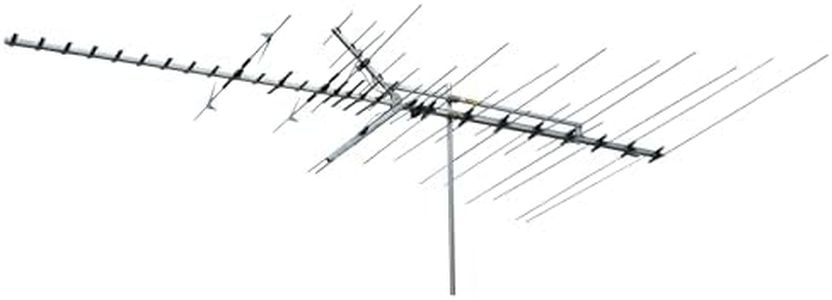
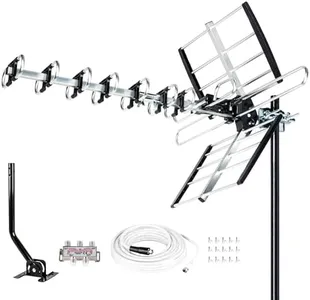
Winegard HD8200A Long Range Outdoor HDTV Antenna - 65+ Mile Range, High-VHF/UHF, 4K Ultra-HD Ready, Free Local Channels, Amplify with Boost XT LNA-200

Rating
8.8
Range
Frequency Bands
Antenna Type

Most important from
168 reviews

Range
Delivers strong reception for distant channels up to 65 miles away, making it ideal for rural or fringe viewing where signals are weak.
Frequency Bands
Does not support low-band VHF channels well, focusing instead on high VHF and UHF frequencies which cover most current broadcasts.
Antenna Type
Requires precise aiming due to a sharp beamwidth; even slight misalignment can cause significant signal drop.
Gain
High gain antenna does not benefit from a preamplifier unless located more than 30 miles from broadcast towers, as preamps can cause signal overload and interference.
Weather Resistance
Built with durable materials that withstand harsh weather, ensuring consistent performance through rough winters.
Installation
Installation demands careful setup—mounting height, rotation clearance, and proper coax connections are critical for optimal performance.

The Winegard HD8200A is designed primarily for outdoor use and excels at picking up local TV channels from over 65 miles away, making it ideal for rural or remote areas where signals tend to be weaker. It covers a wide range of frequencies, including Low-Band VHF, High-VHF, and UHF, which means it can receive most broadcast channels available today. The antenna type is a high-gain model, which helps improve signal strength and reduces interruptions, especially useful if you have a clear line of sight to the broadcast towers. The product is built with precision electronics that efficiently transfer digital signals and is weather-resistant, so it holds up well in outdoor conditions without frequent maintenance. Installation usually involves mounting it outside—on a roof or pole—to get the best possible reception. It supports 4K Ultra-HD and next-generation ATSC 3.0 signals, ensuring you are ready for future improvements in TV broadcast technology.

A notable plus is the option to add an amplifier (Winegard Boost XT LNA-200) if you need to boost the signal further, which can help in extra-challenging reception areas. However, it may require some basic setup effort and proper mounting location to achieve the best performance, which might be tricky for those unfamiliar with antenna installation. While the antenna is solid and built in the USA, it mainly suits users who need robust reception over long distances rather than casual or urban viewers who might get good signals with simpler models. If you want a reliable, durable outdoor antenna that can capture a broad range of channels from far away and be future-proof for upcoming TV standards, the Winegard HD8200A is a strong choice.

Rating
8.8
Range
Frequency Bands
Antenna Type

Most important from
168 reviews

Range
Delivers strong reception for distant channels up to 65 miles away, making it ideal for rural or fringe viewing where signals are weak.
Frequency Bands
Does not support low-band VHF channels well, focusing instead on high VHF and UHF frequencies which cover most current broadcasts.
Antenna Type
Requires precise aiming due to a sharp beamwidth; even slight misalignment can cause significant signal drop.
Gain
High gain antenna does not benefit from a preamplifier unless located more than 30 miles from broadcast towers, as preamps can cause signal overload and interference.
Weather Resistance
Built with durable materials that withstand harsh weather, ensuring consistent performance through rough winters.
Installation
Installation demands careful setup—mounting height, rotation clearance, and proper coax connections are critical for optimal performance.

Buying Guide for the Best Outdoor TV Antennas

When shopping for an outdoor TV antenna, your main goal is to find one that captures as many channels as possible with consistent quality, based on where you live. Antennas can differ greatly in terms of how far they reach, how many directions they pick up signals from, and how well they stand up to outdoor conditions. To pick the best fit, think about your location, the distance to the nearest broadcast towers, and any obstacles (like tall buildings or hills) that might interfere with signals. It's also important to consider how you plan to mount the antenna and whether you want to set it up for multiple TVs.
Range (Reception Distance)Range describes how far an antenna can pick up signals from broadcast towers. This is crucial because if the towers are far away, a stronger or higher-range antenna is necessary for good reception. Ranges are typically specified in miles or kilometers. Short-range antennas (up to 30 miles) are suitable for urban or suburban locations close to towers. Mid-range models (30–60 miles) work for suburbs or semi-rural areas. Long-range antennas (above 60 miles) are intended for rural locations far from broadcast sources. To pick the right range, you should check how far your home is from the nearest TV transmission towers using online tools and choose an antenna that covers that distance.
Directionality (Directional vs. Omnidirectional)Directionality tells you whether the antenna picks up signals best from one direction or from all around. Directional antennas focus on signals from a specific direction and tend to have better range and clarity when pointed at a particular tower, which is best if you know all your channels come from the same area. Omnidirectional antennas receive signals from all directions, useful if channels come from multiple locations or you don't want to aim the antenna precisely. Consider a directional antenna if local towers are grouped together, or omnidirectional if they're spread out.
Frequency Bands Supported (VHF/UHF Compatibility)TV channels are broadcast on different frequency bands, mainly VHF (Very High Frequency) and UHF (Ultra High Frequency). A good outdoor antenna should receive both since channels in your area can be on either band. Some antennas work only with UHF or VHF, while many cover both. It's best to look up what channels are available near you and which bands they use, then make sure your antenna supports those frequencies for broader channel access.
Antenna Size and Mounting OptionsOutdoor antennas vary in size—from compact units to large multi-element arrays. Size can affect performance, especially for long distances, with bigger antennas often being more powerful. However, larger models need sturdy mounting and more space, so check your available area and installation preferences. Also consider if the antenna includes mounting hardware or if you'll need to buy it separately, and whether it can be easily installed on your roof, wall, or attic.
Weather Resistance and DurabilitySince the antenna will be outside, it needs to withstand all kinds of weather. Weather-resistant antennas are built to handle rain, sun, wind, and sometimes snow, with features like UV-resistant plastic, rust-proof metals, and sealed joints. If your area experiences harsh conditions, prioritize durability to avoid frequent replacements.
Amplification (Amplified vs. Non-Amplified)Some antennas have a built-in amplifier to boost weak signals, especially useful if the signal from towers is faint, you have long cables, or there are obstructions. However, amplifiers can sometimes pick up noise along with the signal if you're close to towers. If you’re far from towers or have signal barriers, an amplified antenna may help, but for strong signals or close locations, a non-amplified model is usually sufficient.
Multiple Output SupportIf you plan to connect the antenna to more than one TV, check whether it supports multiple outputs. Some antennas need splitters or built-in multi-TV support for this. Decide based on how many TVs you want to serve and ease of setup.

FAQ